VisLoc - Real Time Visual Localization for AR
The Problem & Product Discovery
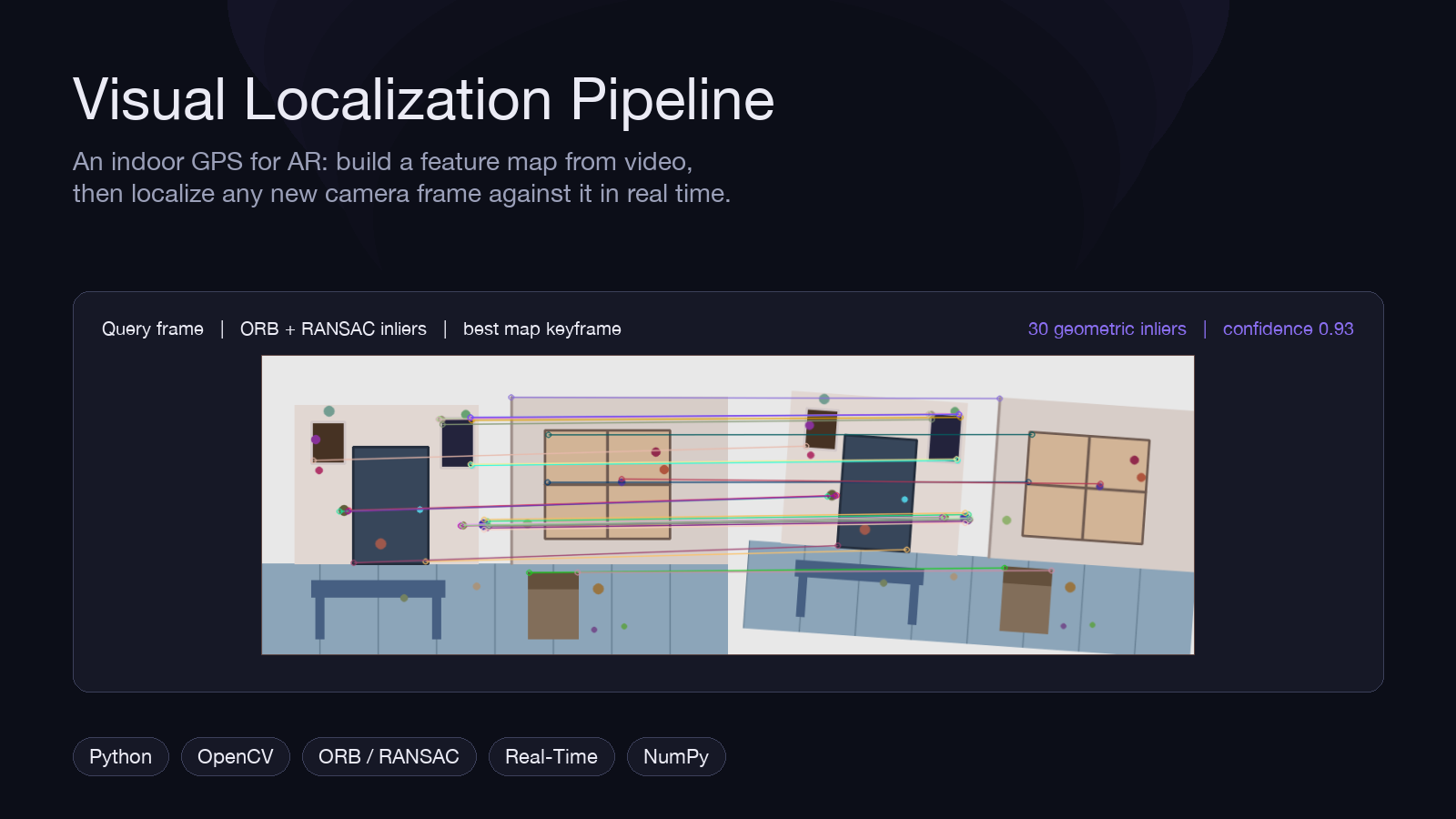
GPS doesn't work indoors, but augmented reality experiences need to know where the camera is in a space for navigation, object anchoring, room-scale AR. I wanted to build the foundation of an "indoor GPS" from scratch, using only a phone camera and computer vision. The technical question was clear: given a short walkthrough video of a room, can I take any later photo from that room and tell where it was taken? The product question was the harder one — how do I make this real-time, robust to viewpoint changes, and visible enough that someone watching the demo immediately understands what's happening.
Architecture & Execution
I designed a modular five-stage pipeline (feature extraction → matching → map building → localization → visualization) where every stage can be swapped without touching the others. The baseline runs OpenCV ORB features with brute-force Hamming matching, Lowe's ratio test to filter ambiguous correspondences, and RANSAC homography estimation for geometric verification. Confidence is the ratio of geometrically-consistent matches to descriptor-matched ones — a number you can trust. I built a webcam demo with a smoothed HUD overlay (majority-vote prediction over a 5-frame window, exponential fade on the confidence bar) so the system feels responsive and trustworthy in motion. The whole thing is architected to evolve: a registry pattern in the feature extractor means swapping ORB for SuperPoint is a 10-line change.
Tech Stack
My Role
Sole engineer - pipeline design, implementation, testing, demo UX